
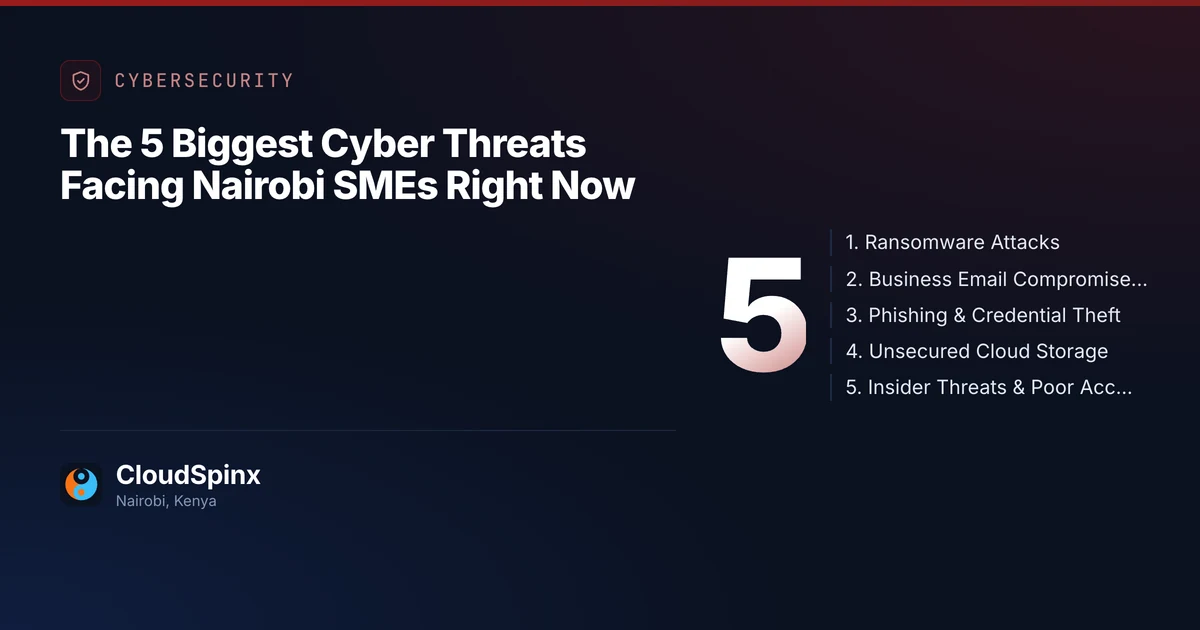
Kenya's digital economy is growing fast, and so is cybercrime targeting it. The Communications Authority of Kenya's National KE-CIRT/CC detected about 8.6 billion cyber threat events across the 2024/25 financial year (July 2024 to June 2025), summed from its quarterly reports, and SMEs are in the crosshairs.
The good news is that most of these attacks are stopped by controls a small business can afford. The bad news is how rarely those controls are actually switched on.
Here are the five threats worth defending against first, and what to do about each one.
1. Ransomware Attacks
Ransomware encrypts your files and demands payment, usually in cryptocurrency, to unlock them.
Paying guarantees nothing, including getting your data back.
Attackers go looking for outdated Windows systems and unpatched software, because those are the doors that open without effort. Four controls cover most of the risk:
- Regular backups, tested by restoring from them, with one copy offline or in a separate cloud account
- Patching for every operating system and application, on a schedule
- Endpoint detection and response (EDR) software on every device
- Network segmentation, so ransomware on one machine cannot reach every system
2. Business Email Compromise (BEC)
An attacker gets into a business email account, or spoofs one convincingly, and impersonates a senior executive asking for an urgent transfer. Finance teams are the primary target.
Multi-factor authentication is the first fix. Microsoft's own figure is that MFA blocks 99.9% of account compromise attacks, with one catch the same post spells out: old protocols that cannot do MFA are how attackers walk around it, so block legacy authentication too. Then add a rule that any payment request received by email is confirmed by voice on a known number, and set your mail system to flag outside emails that claim to come from inside your domain.
3. Phishing & Credential Theft
Phishing emails trick staff into clicking malicious links or typing credentials into fake login pages. KCB, Equity and M-Pesa branding is trusted everywhere in Kenya, which makes it an effective local lure. The better attacks are researched: a look at your LinkedIn page, then a convincing note from your bank, a supplier or KPLC. Simulated phishing tests train staff better than a slide deck does. Pair them with email filtering that has anti-phishing rules (Microsoft Defender for Office 365, or the advanced protections in Google Workspace), a password manager so every service gets a unique password, and MFA everywhere, starting with cloud services and banking platforms.
4. Unsecured Cloud Storage
Google Drive, OneDrive and Dropbox make sharing easy, and that is the problem. A folder shared with "anyone with the link", or a misconfigured storage bucket, puts client contracts, employee records and financial data in front of anyone who finds the URL.
Audit sharing settings every quarter. Give staff access to what their role needs and nothing more. Turn on the data loss prevention policies your cloud platform already includes, and encrypt sensitive files before they go into shared storage.
5. Insider Threats & Poor Access Control
Not every threat is external.
Disgruntled employees, contractors with more access than the job needs, and accounts nobody closed when someone left are all common ways in, and they are easy to underestimate because nothing looks like an attack.
Review access every quarter and strip permissions from people whose role changed or who have gone. Make revoking every system login part of a written offboarding checklist. Log access to sensitive data, privileged accounts first, so a quiet export does not stay quiet. Once a business is big enough that nobody can list every account from memory, an identity and access management system earns its cost.
Start With an Independent Review
Most of the five come down to settings nobody has checked since the system went in. Our cybersecurity assessment covers all of them, plus network security, data protection compliance and staff security awareness, and ends in a prioritized action plan.
Book a free cybersecurity consultation →
Download: The 5 Biggest Cyber Threats Facing Nairobi SMEs Right Now
Enter your work email. We'll send the PDF download link to your inbox.